


Slideshow with Dave Hayward, Ep 13, Season 2 (#26)
Episode links
Eight pages used to take a week to write. Now they take about 40 seconds, and someone still has to read them.
Subscribe to Bright Objects, our newsletter: Ideas and insights on how to navigate business, marketing, and technology, with a personal lens. Learn lessons from inside ambitious businesses, every week.
https://brightobjects.europa.nz/
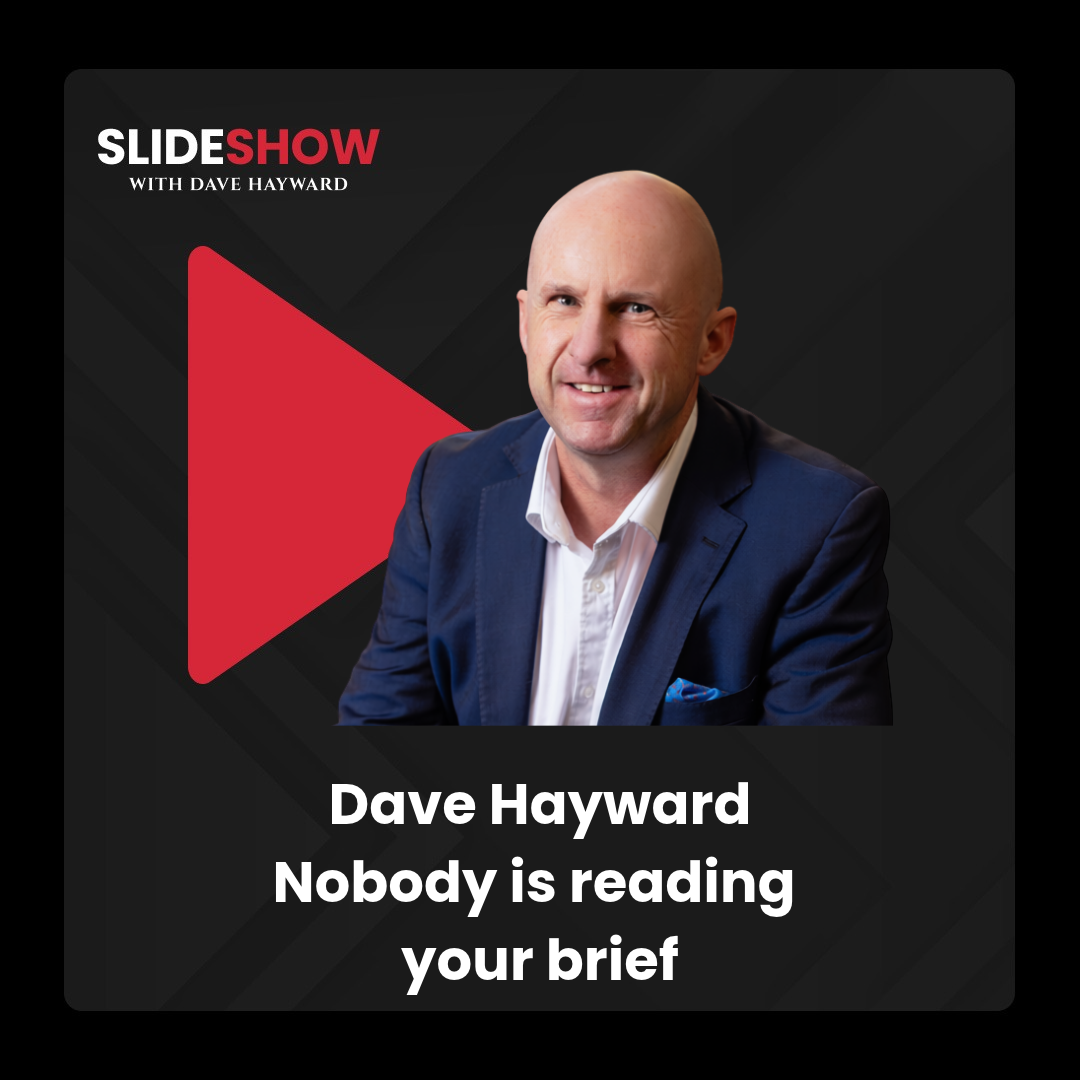
This solo episode started life as an edition of Bright Objects, and it became our most read edition by a wide margin. It touched a nerve because everyone is living it: briefs, decks and emails that look polished, run long and say very little. AI has collapsed the distance between labour and output. The cost of writing didn’t disappear. It moved to the reader, whose time and attention haven’t changed at all.
To make the case for radical ownership, Dave takes a detour through Kirby Ferguson’s Everything is a Remix, and through Raymond Chandler, who wrote on yellow paper cut in half and sold an 18,000-word story for a cent a word. Anything that didn’t earn its place went back through the typewriter. Then Descript CEO Laura Burkhauser explains why writing is two acts: working out what you think, then putting it into words. Hand the second act to AI and it’s slightly tacky. Hand over the first and call it your own, and it’s a severe lack of judgement.
Dave uses AI every day. His point is simpler: if you send it, you own it. He finishes with three muscles for writing in the AI age. Sign your name to it. Treat discernment, creativity and taste as your edge. And protect your cognitive load, so you still have room to think.
Links and things
Slideshow with Dave Hayward podcast links:
Produced by Europa Creative Partners
Chapters
00:00 Writing is almost free. Reading isn’t
01:46 AI is the biggest remix machine ever built
03:07 Eight pages used to mean something
04:51 Raymond Chandler and a cent a word
05:56 Laura Burkhauser: writing is two acts
06:34 Radical ownership and three muscles for the AI age
08:11 Are you with me?
Keywords
AI slop, AI writing at work, AI generated content, radical ownership, writing with AI, business writing, writing a brief, discernment and taste, cognitive load, Raymond Chandler, Everything is a Remix, Laura Burkhauser, Descript, Bright Objects, Slideshow with Dave Hayward
FAQ (for humans and search engines)
Is it OK to use AI to write at work?
Yes, and Dave uses it every day. The rule is that if you send it, you own it: what’s in it, what’s left out, how long it is and what it’s for. Laura Burkhauser draws the line at thinking. Getting AI to put your thinking into words is fine at work. Handing over the thinking itself and calling it yours is a severe lack of judgement.
Why does AI-generated content cost the reader more than the writer?
AI has collapsed the distance between labour and output. An eight-page document that once took a week now takes about 40 seconds, but it still takes a person the same time to read. The cost hasn’t gone away. It has moved from the writer to the reader.
What does radical ownership of your content mean?
It means signing your name to everything you send and standing behind every part of it. You decide what goes in, what stays out, how long it runs and what it’s trying to achieve. AI can help with the drafting, but the judgement has to be yours.
How do you stand out when everyone uses AI to write?
Discernment, creativity and taste. AI is a pattern-matching machine, so the longer you prompt it, the closer it pulls you to the middle. Taste is built from the best of what came before, and that’s what lifts your work above a sea of beige.
What should a good brief actually do?
Answer one question: what problem are we actually solving? Dave’s example was an eight-page brief full of channels, posting schedules and ads, most of it wrong for the business, and none of it answered that question. A shorter brief that names the problem is worth more than a long one that lists tactics.