
If your B2B marketing isn’t working the way it used to, stop blaming the algorithm. The problem is abundance: there is more content than ever, and most of it is easy to make. Here’s why buyers now ignore easy content, why effort has become the signal they trust, and three ways to cut through.
The abundance idea belongs to Alex M H Smith, a London strategist who writes the Basic Arts newsletter (sources at the end, as usual). I’m almost never happier than when I meet an idea for the first time, and this one explained a lot.
Why B2B marketing stopped working: everything is easy now
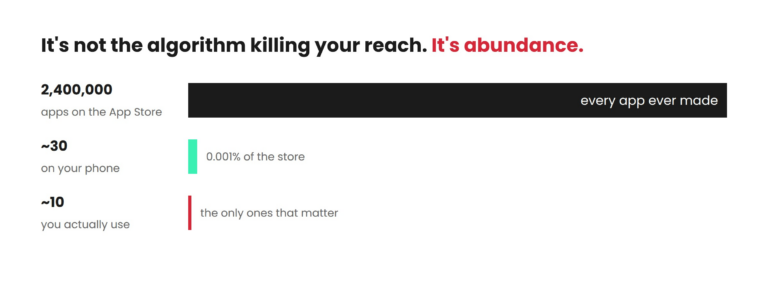
You’ve probably got 30 apps on your phone. You use 10 of them. There are around 2.4 million on the App Store. Does that mean you’ll use more apps? I don’t think so.
Email is mail, minus friction. Google is the Yellow Pages, minus friction. AI is fast, easy everything.
“As we have been offered the fast-and-easy at every turn, we have gradually lost tolerance for the slow-and-difficult.” Alex M H Smith
And with it, we’ve lost the fruit of the slow and difficult, which is mastery.
Three years ago, being good at writing was an advantage. Now everyone can produce words. Not necessarily good ones, or even logically coherent ones. But a lot of them, easily. So if fewer people seem to be noticing your marketing, that’s why. Everyone is drowning in the same fast, easy stuff.
For a business trying to be noticed, that leads to an uncomfortable conclusion. When anyone can make marketing for nothing, the marketing that costs you something is the only kind a buyer has any reason to believe.
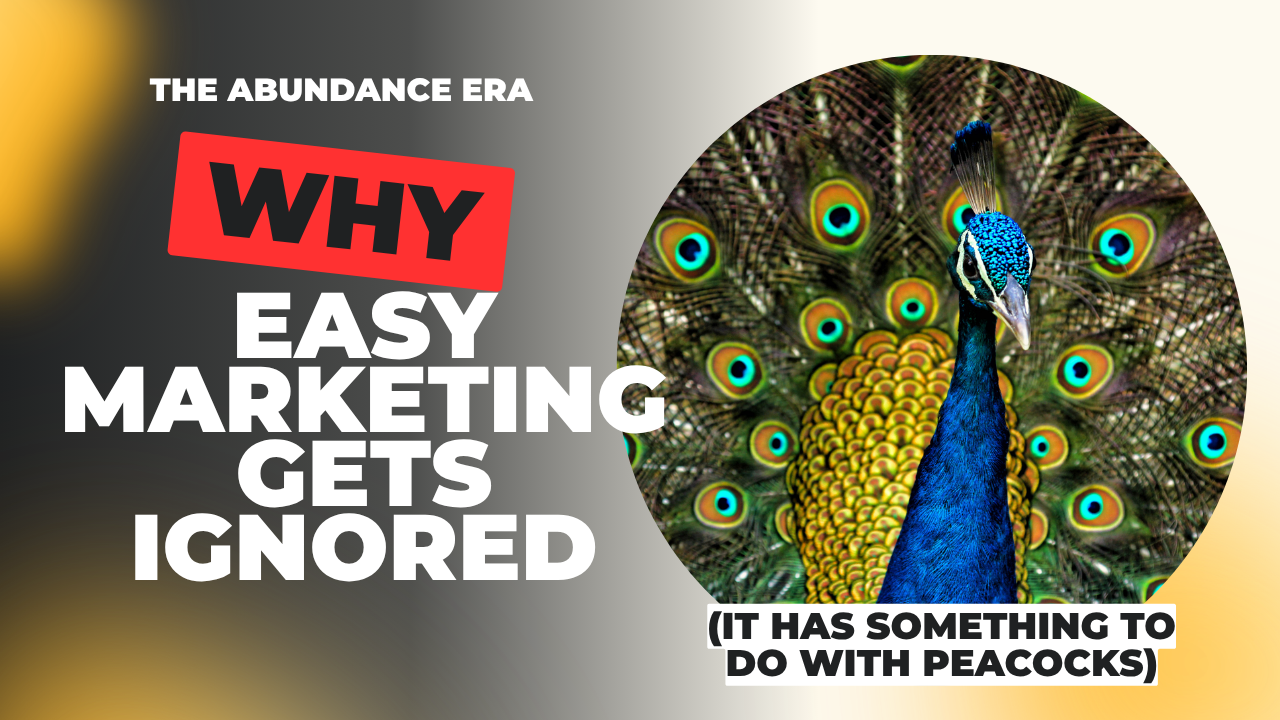
What a peacock’s tail teaches B2B marketers
In 1975, the Israeli biologist Amotz Zahavi published a paper that puzzled his peers. He was trying to explain the peacock’s tail. It’s enormous and heavy, and it makes the bird slower and easier for a fox to catch. By every sensible measure it’s a liability. So why would evolution keep it?
Zahavi’s answer became known as the handicap principle. The tail is trusted precisely because it’s expensive. A weak bird couldn’t afford to carry one. The peahen doesn’t need to check the peacock’s health; she just looks at the tail. The cost is what makes the signal honest.
Rory Sutherland brings this straight into marketing in his book Alchemy and calls it costly signalling. Why does a bank build a marble lobby? Why does a company that could email you fly someone across the country instead? Because the buyer’s brain reads the expense and the time as commitment. You wouldn’t spend this if you weren’t planning to be around.
That’s the lesson for B2B marketing. Cheap signals get ignored, and rightly so. Buyers can smell a template. What still cuts through is work that visibly cost you something to make.
Our own peacock’s tail
A peek behind the curtain. I use AI a lot, including an AI content engine that hands me ideas (of varying quality), outlines and first drafts. It’s useful for beating the blinking cursor. Then I rewrite, top to bottom, aggressively. By the time I’m finished, very little of the draft remains.
My podcast, Slideshow with Dave Hayward, is the same. We still edit it by hand, twice a month, and you have to listen to an hour-long conversation several times before it’s right. For a long time I filed all that under “problems with the format”. I’ve stopped. The effort is what makes it worth watching.
The 95:5 rule and the pay-off for effort
This connects to money, not just philosophy. I made this case at a client workshop recently, setting the scene for a brand-building campaign in a room full of people who don’t spend their days thinking about marketing.
The Ehrenberg-Bass Institute, working with LinkedIn’s B2B Institute, found that at any moment about 95% of the businesses that could buy from you aren’t in the market. They’re not shopping, and they have no reason to click your ad. The 5% who are ready will go with whoever is already in their heads.
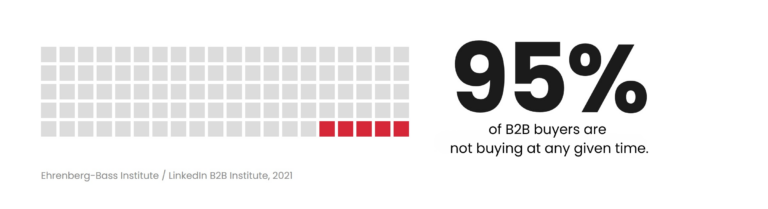
So the whole job of B2B brand building is this: be the name the other 95% remember when their turn comes. If “brand” is a distracting word, swap it for “reputation”.
And the things people remember are, almost by definition, the things that took effort. Nobody remembers the fourth AI-written LinkedIn post of the morning. People remember the workshop, the research nobody else bothered to do, the long conversation, the thing that was clearly a mission to make.
Three ways to make your B2B marketing work again
Alex has three antidotes to abundance:
- Use your credibility. George Clooney didn’t make a better coffee; he made one people noticed. Most of us don’t have his face, but every business has credibility it isn’t spending: qualifications, track record, and people who’d vouch for you. Combined, they’re powerful.
- Do hard things. One consultant did fifty speaking gigs in a year. Another spent thirty grand on a video that got 200,000 views on day one. They’re commitments, and the commitment is the strategy.
- Replace, don’t add. Nobody wants another newsletter, app or thing in the inbox. Liquid Death didn’t ask people to drink more water; it asked them to drink different water. Don’t ask your market for a new slot. Ask them to swap.
Alex closed his essay with a line I’ll borrow: “Mastery is not a bonus. It’s the way.”
If your marketing has gone quiet and you’d like a second opinion on where the effort should go, book 30 minutes with me.
Questions people ask
Why has my B2B marketing stopped working?
Often because there’s far more content competing for attention, and most of it is cheap to make. Buyers have learned to ignore easy content and pay attention to work that visibly took effort.
What is costly signalling in marketing?
The idea, from Rory Sutherland and the biologist Amotz Zahavi, that people trust signals that were expensive to send. Effort, time and commitment all read as credibility.
What is the 95:5 rule?
Research from the Ehrenberg-Bass Institute and LinkedIn’s B2B Institute found that only about 5% of potential B2B buyers are in the market at any one time. Brand building reaches the other 95%.
This article first appeared in Bright Objects, my fortnightly newsletter on brand, marketing strategy and AI for business and tech leaders. Subscribe here.
Sources and further reading
- Alex M H Smith, “Nobody is good at anything anymore” (September 2026), and Basic Arts
- Alex M H Smith, “Why marketing isn’t working anymore” (video)
- Amotz Zahavi, “Mate selection: a selection for a handicap”, Journal of Theoretical Biology (1975)
- Rory Sutherland, Alchemy
- Byron Sharp, How Brands Grow
- Professor John Dawes, “Advertising effectiveness and the 95-5 rule”, Ehrenberg-Bass Institute for the LinkedIn B2B Institute (2021)
- Alex M H Smith on Slideshow: Why your moat is crumbling
If you know your business is all steak and needs some sizzle….. we’d love to hear from you.

Dave Hayward


Subscribe to Bright Objects Your essential marketing & tech insights
Warm personal stories wrapped around solid business, revenue and marketing strategy, how-tos, technology discussion (especially AI), philosophies and tactics. Occasionally, we’ll talk about personal productivity and things important to us (like astronomy and dogs).