The campaigns underperform. The messaging doesn’t land. The pipeline stays thin. And the response, almost universally, is to do more. But if your B2B brand positioning strategy is unclear, doing more just accelerates the problem.
What follows uses one of the most instructive brand decisions in history as a lens for why positioning fails, and what to do about it.
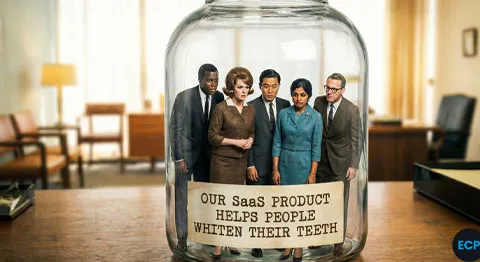
You can't read the label from inside the jar
In 1971, Phil Knight had to send a name to his shoe factory by telex. Production started Friday. Three options were on the table: Falcon, Nike, and his own personal favourite: Dimension Six.
His team had described Dimension Six (correctly) as “unspeakably bad.”
Knight couldn’t see it. This is one of those situations where it’s impossible to see the outside of the label because you’re inside the jar. He’s the boss. He’s come up with the name, the name he wanted to name his whole business over.

It’s difficult to know your positioning from inside your business
The team’s response? “Maybe it’ll grow on us.”
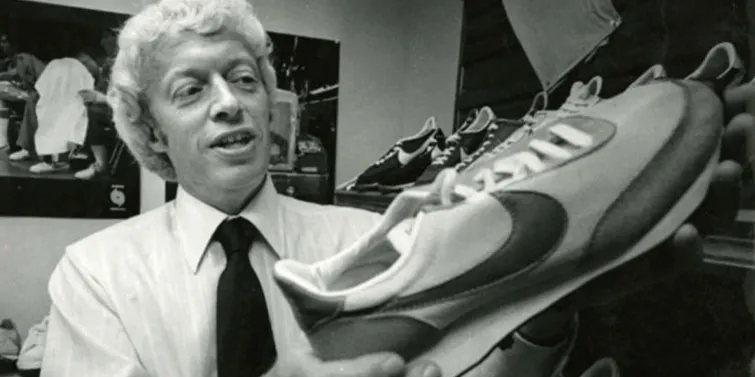
Phil Knight, c. 1971, with his correctly named shoes
Nike was almost called Dimension Six. Here's why that matters
The Nike story has come to mind because it’s not about the company’s name. It’s about positioning. We’re in the planning season with customers whose financial year starts in April. And positioning is coming up a lot.
As Peter Drucker wrote in 1954, a business has only two functions: marketing and innovation. Underpinning this philosophy is the strategic infrastructure that sits upstream of both: understanding what the market actually needs and positioning your company to deliver it.
He wasn’t talking about marketing tactics, sales channels, or product development.

It might not be the channels you’re using: it might be the message you’re sending
It’s the decision that sits upstream of everything else. The story you occupy in your current and future customers’ minds.
In plainer language: the product solves the problem. The story makes people choose you over everyone else, solving the same problem.
Enter: positioning.
The positioning problem isn’t a marketing problem. It’s a business problem, and it’s almost always invisible from inside.
Describing your capability is Dimension Six. Describing a problem is Nike
One way to position is to describe your capabilities. The other, more successful, way is describing a problem you’re solving and how you made the customer feel.
An example. “We help organisations digitally transform” is Dimension Six. It describes something real. But the person you’re trying to reach isn’t thinking about something as amorphous as digital transformation. They’re thinking about the board meeting where the numbers didn’t add up. About how, every month, it’s a nightmare to pull the figures together. About the way the competition’s new technology is making them significantly faster and more efficient.
“Saving your ass at board reporting time” is probably not quite Nike-type positioning. But it’s getting there.
As Dave Gerhardt and Katelyn Bourgoin explored in Episode 344 of the Exit Five podcast, the businesses that win in B2B develop an ownable idea, a position specific enough to mean something and distinct enough to be remembered. Most B2B messaging never gets there because the positioning work that precedes it was never done properly.
Positioning is not a tagline exercise. It's a commercial decision
Good B2B brand positioning determines which customers you pursue, which problems you solve, what you say to them, and how your sales and marketing connect. Get it right and everything downstream becomes easier. Get it wrong, and no amount of execution fixes it.
The clearest framework for this comes from April Dunford’s Obviously Awesome: for a specific audience, with a specific problem, your product delivers a specific outcome in a way that alternatives don’t.
Four components. Most B2B businesses struggle with all of them.
Three uncomfortable tests worth running right now
It’s planning season, so we’re doing a lot of this work. But it doesn’t mean downing tools or your LinkedIn feed going quiet. You can run and gun.
Here are three ideas, hand-selected from real life, Google, and Claude, to test your positioning, gather useful data, and pivot if needed.
1. Run the uncomfortable sentence test. Take whatever you’re currently saying about what you do and ask one question: does this describe a capability, or does it name a problem my customer is actually feeling? If it’s right, it should make you feel a little uncomfortable. An example: “Is your AI environment secure? Most businesses aren’t ready.”
2. Ask the people who didn’t convert. High engagement with no meetings is a specific signal: the market recognises your category but doesn’t feel the urgency. Five honest messages to five warm contacts will give you some of the most valuable data you can imagine.
A possible opening line: “I’m doing a bit of a listening tour. We’ve been putting stuff out there, and I want to make sure we’re actually talking about the right problems. You seem like someone who’d give me a straight answer.”
3. Don’t wait for a rebrand. Positioning work doesn’t require a pause. I recently did this for a client mid-campaign. The output was twelve slides and a few focused weeks. It suddenly became simple to stack-rank activities because they’re now expressions of an overall positioning and strategy.
You can run all three of these tests yourself, and you should. But if the exercise surfaces something uncomfortable, and it usually does, that’s the moment a good strategist earns their keep. Done well, this kind of work takes days or weeks rather than months. It costs a fraction of what you’re currently spending on campaigns that aren’t converting at the rate they should.
The upstream fix is almost always cheaper than the downstream symptom.
Just do it
Nike has been worth over $100 billion. Dimension Six would have been a footnote.
The difference wasn’t the product. It was the clarity of what the brand stood for, who it was for, and why it mattered. That clarity is available to any B2B business willing to do the upstream work, regardless of budget, headcount, or how long the problem has been sitting there.
If you’re in planning season and B2B brand positioning strategy is on the agenda, that’s a conversation worth having. Take a look at our strategy work to see how we approach it, or get in touch directly and let’s set something up.
And if you’re thinking about how AI fits into your marketing planning this season, this conversation with Laura Burkhauser is worth your time.
Frequently asked questions
What is B2B brand positioning?
Why does B2B marketing messaging fail?
How do you build a positioning strategy for a B2B company?
What should B2B marketers focus on during planning season?
If you know your business is all steak and needs some sizzle….. we’d love to hear from you.

Dave Hayward


Subscribe to Bright Objects Your essential marketing & tech insights
Warm personal stories wrapped around solid business, revenue and marketing strategy, how-tos, technology discussion (especially AI), philosophies and tactics. Occasionally, we’ll talk about personal productivity and things important to us (like astronomy and dogs).