
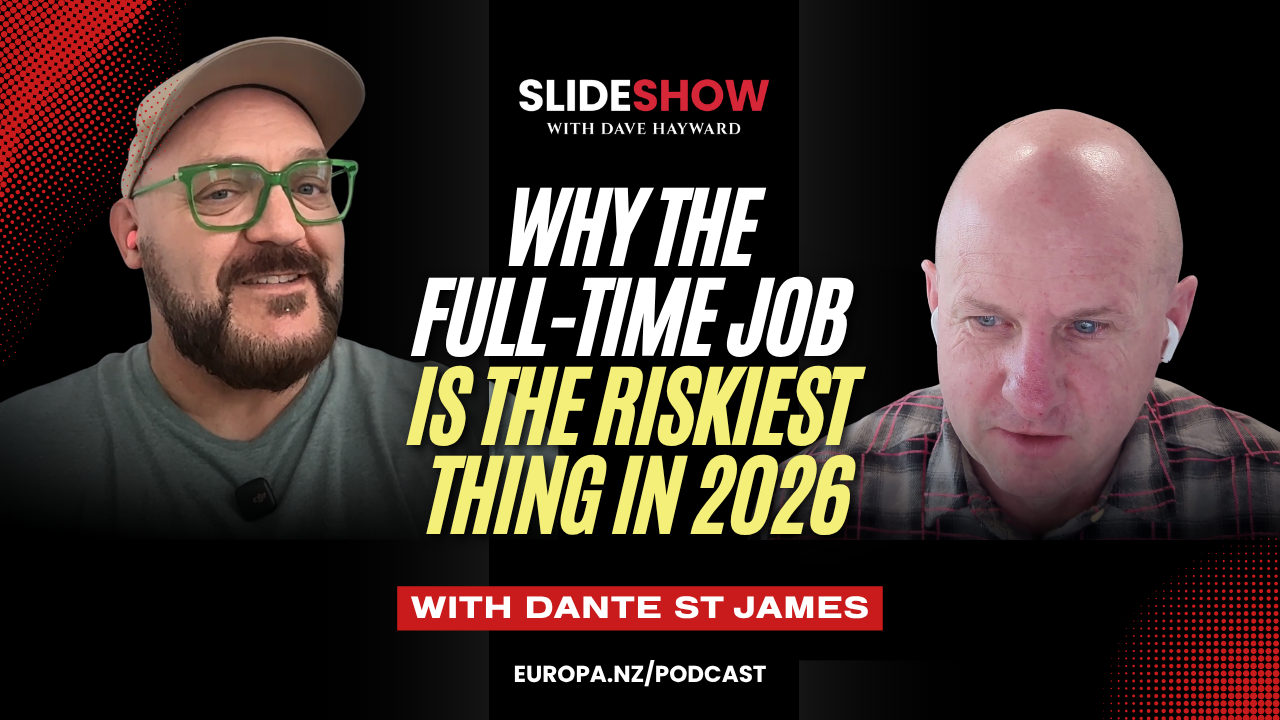
If your business swings between flat-out busy and worryingly quiet, you’re in the feast or famine cycle. It’s rife in professional services and tech. Here’s why it happens, what a serial entrepreneur’s 20% rule teaches about concentration risk, and three things to do about it this week.
You’re not talking to enough people
Fifteen years ago I downloaded a PDF called Email It: A Seller’s Guide to Emails That Work, by Bill Caskey and Bryan Neale. I expected email templates. What I got was philosophy.
The first two pages laid out four principles for selling. One was abundance. The idea is simple: if you’re nervous about whether a deal will close, you’re not talking to enough people.
When your pipeline is full, no single prospect has power over you. Your behaviour changes. You listen better. You stop chasing. People sense it, and they trust you more.
I used to mentor business owners who didn’t know how to sell. They’d come to me stressed about a deal, and I’d tell them the same thing every time. The answer isn’t what to do next on this sale, or finding the perfect words in the perfect order. Talk to more people, and the problem disappears.
A cafe for the price of three plane tickets
I went looking for that PDF again after my conversation with Dante St James on Slideshow with Dave Hayward. Dante is a serial entrepreneur in Darwin. He runs six cafes, three menswear stores, three barbershops and three training businesses, and he’s a LinkedIn Top Voice.
His first cafe cost him three COVID-era plane tickets (about $18,000). In April 2020, a Brazilian family in Cairns was desperate to sell their cafe and get home as borders closed. Nobody was buying cafes. Dante asked what it would take. Their answer: pay for our flights and it’s yours, staff included.
Two weeks later Australia locked down. His team found a portable coffee cart and got permission to set up inside a government building where workers couldn’t leave for coffee. Then the state government offices wanted one. Then he needed five carts. Asset finance companies thought he was mad until he showed them the government agreements. $125,000 of coffee cart financing later, the cafes funded everything that came after.
The 20% rule: managing concentration risk
Dante’s 20% rule is a sibling to Caskey and Neale’s abundance. No single activity can account for more than 20% of his total income.
He thinks of his businesses as fire hoses. If one dips, he turns up another. If one fails completely, he loses 20%, not everything, and he can replace it from an area that’s already running.
He isn’t casual about it. He has 72 people on payroll, and their rent depends on him. But the structure means no single failure is fatal. He starts a new business almost every month, expects most to fail within weeks, and moves on without ego. When I asked about stress, he said: “I’ve gone through enough failures to know that you don’t die.”
Why the feast or famine cycle happens
Most of the businesses I work with have the opposite problem. They get busy, love the work, do the work, and come out the other side with no pipeline. Then a couple of months with no revenue eat the profit from the busy period.
It happens because marketing and business development feel like something you do when you need work, not something that runs as a system. Dante calls it the difference between marketing as a tactic and marketing as a strategy. The tactic is: I need a thing, so I go and get it, and then I stop. The strategy is: what am I doing to make sure the next thing is always on the way?
Dante also made a sharper point. He believes the most dangerous position in 2026 is a single source of income, and that a full-time job is maximum concentration risk. Whether or not you agree, the principle scales to businesses. If one client, product or channel makes up most of your revenue, you’re one bad quarter from trouble. (I ran the test on my own business as I wrote this. It’s a useful exercise.)
Three ways to break the feast or famine cycle
- Run the concentration test. Look at your revenue by client, product and channel. If any single source is more than 30 to 40% of the total, that’s your vulnerability. You don’t have to fix it this week. You do need to know about it.
- Keep the system running when you’re busy. The worst time to stop marketing is when you’re flat out, because that’s when you build the gap that hits in three months. Even a simple rhythm keeps the pipeline alive: one piece of content, one conversation and one follow-up a week. Your energy is better when you don’t need the business, and it shows.
- Detach from any single outcome. This is Caskey and Neale’s other principle. If you’re too attached to whether one deal closes or one hire works out, you’ll make worse decisions. Abundance is a structure, not a feeling. Build enough activity that no single result can ruin your month.
If you want help building a marketing system that keeps working while you’re busy, book 30 minutes with me.
Questions people ask
What is the feast or famine cycle?
It’s the pattern where a business is overloaded with work for a stretch, stops marketing because it’s busy, and then hits a quiet period with nothing in the pipeline.
What is client concentration risk?
It’s the risk that comes from relying on one client, product or channel for a large share of revenue. If that source slows or leaves, the whole business feels it.
How much revenue should one client make up?
There’s no single rule. As a warning sign, look closely at anything above 30 to 40% of revenue. Dante St James keeps every activity below 20%.
This article first appeared in Bright Objects, my fortnightly newsletter on brand, marketing strategy and AI for business and tech leaders. Subscribe here.
Sources and further reading
- Slideshow with Dave Hayward, Dante St James: Why the full-time job is the riskiest thing in 2026
- Bill Caskey, Bryan Neale and Brooke Green, Email It: A Seller’s Guide to Emails That Work: caskeyone.com
- Dante St James on LinkedIn
If you know your business is all steak and needs some sizzle….. we’d love to hear from you.

Dave Hayward


Subscribe to Bright Objects Your essential marketing & tech insights
Warm personal stories wrapped around solid business, revenue and marketing strategy, how-tos, technology discussion (especially AI), philosophies and tactics. Occasionally, we’ll talk about personal productivity and things important to us (like astronomy and dogs).