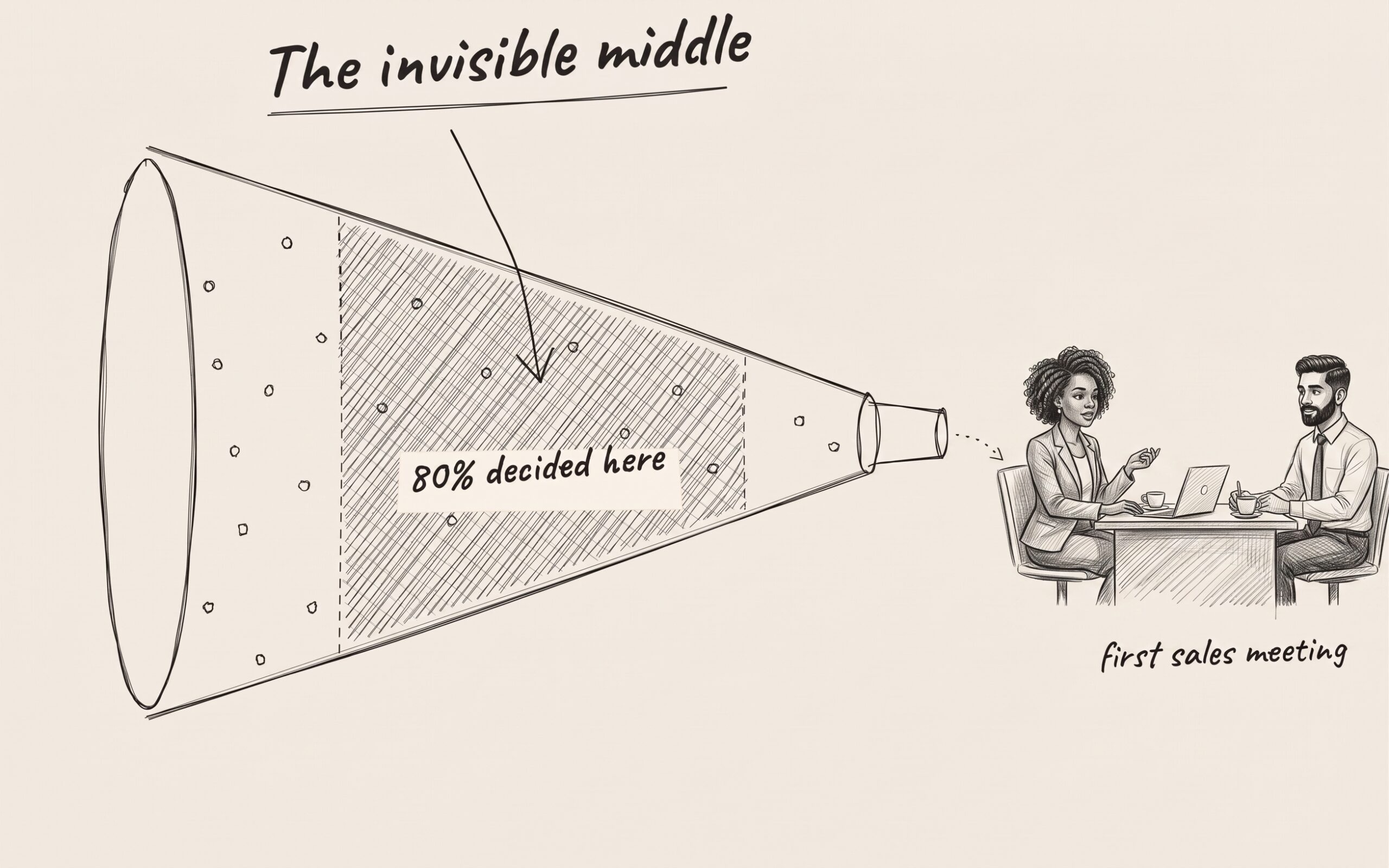
Your future customers aren’t ready to buy yet. But they’re already deciding who they’ll go with. Most of the B2B buyer journey happens before anyone talks to you, in a stretch I call the “invisible middle”. Here’s what the research says, and how to reach buyers while they’re still deciding.
The B2B buyer journey is mostly over before the first meeting
Last week, I had a new business appointment, and I felt alive and excited as always. I reckon if you’re not excited about a meeting that could change the course of your business, even in a small way, something’s wrong.
For most of my career, I thought the first sales meeting was the starting gun in a running race. In truth, the race is nearly done.
6sense surveyed nearly 4,000 B2B buyers for its 2025 Buyer Experience Report. On average, buyers first contacted a supplier when they were 61% of the way through their buying process. 94% had already ranked their shortlist before they contacted anyone, and they bought from their top-ranked supplier 77% of the time.
So your content is running a race that happens before a single word is said at a first meeting. Whether you know it or not, most of the buying cycle happens well before that point. That’s the invisible middle.
The 95:5 rule: most of your buyers aren’t buying yet
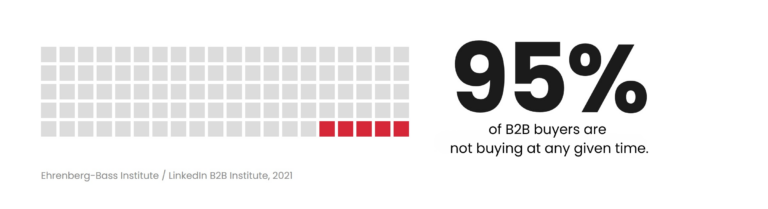
At any given time, about 95% of your potential buyers aren’t in the market. That’s the 95:5 rule, from Professor John Dawes at the Ehrenberg-Bass Institute, working with LinkedIn’s B2B Institute. Those buyers aren’t buying. But they are deciding.
To reach them, you need to show up consistently, with creative and relevant content, long before they’re ready to talk. It’s the same reason brand strategy matters in B2B: when one of the 95% becomes one of the 5%, they call the name they already know.
Why buyers feel they know you before you’ve met
In 1956, the sociologists Donald Horton and Richard Wohl coined a term for the one-way connection audiences were forming with television and radio presenters: the parasocial relationship.
Your buyers are building that kind of relationship with you right now, from your posts, your newsletter and what your people say about you. A consistent content engine is how you talk to people while they’re deciding.
Good content is a tension between magic and structure
What makes a great piece of creative? For my 7th Form art teacher (that’s Year 13, kids), Alastair Nisbet-Smith, it was the tension between magic and structure. It’s as true for business content as it is for painting.

Lean too far either way and things fall apart. Too much structure, and the work is bland. Too much magic, and it’s a mess. Alastair was a big believer in never letting any single creative element hold you hostage. If you loved a mark but the painting as a whole needed something else, the mark had to go.
One of the painters we studied, Willem de Kooning, spent about two years on Woman I, scraping it back and repainting it. He hated the idea of a fixed style. “Style is a fraud,” he said. His work endures because it kept that tension alive, and it reached a kid on the other side of the world decades later. That’s the art equivalent of reaching buyers in the invisible middle.

Mise en place: the structure behind a B2B content strategy
Recently I learnt a phrase every chef already knows: mise en place. Everything in its place. Before service, every ingredient is chopped, measured and within reach. Nobody photographs the chopping board, but no dish gets finished without it.
That’s true of B2B content. Most businesses are cooking to order. It’s Monday morning, and someone is writing Monday’s post.
If you want creative that shows up consistently, the answer is unsexy. It’s structure:
- Do you have three or four themes you keep coming back to, so every post has a reason to exist? (Marketers call these content pillars.)
- Can everyone see the same calendar, six weeks out?
- Does everyone know who approves what, and how long it takes?
- Is it all in one place?
Get that in place and you’ve got room for the magic: reacting to something timely, telling the story only you could tell, and making work people remember. That’s what buyers in the invisible middle hold on to. (If you want help building it, this is the work behind our B2B social media marketing.)
Be a clockmaker, not a time-teller
A good friend and AI wunderkind, Ed Ortega, has a philosophy I admire: he wants himself and his business to be a clockmaker, not a time-teller. (Ed joined me on Slideshow with Dave Hayward to talk about it.)
That’s what your content strategy for next year needs. Be a clockmaker. Build the structure. Then go and make some marks people remember.
If you’d like a hand with your own content mise en place, book 30 minutes with me.
Questions people ask
What is the B2B buyer journey?
It’s the path a business buyer takes from first noticing a problem to choosing a supplier. Most of it now happens before they speak to anyone: research, peer advice and content.
When do B2B buyers first contact a supplier?
In 6sense’s 2025 study of nearly 4,000 buyers, first contact came on average 61% of the way through the buying process, and 94% had already ranked their shortlist.
How do you reach buyers before they’re ready to buy?
Show up consistently with useful, creative content in the places they already spend time, so your name is the one they know when they start shortlisting.
This article first appeared in Bright Objects, my fortnightly newsletter on brand, marketing strategy and AI for business and tech leaders. Subscribe here.
Sources and further reading
- 6sense, 2025 B2B Buyer Experience Report (November 2025)
- Professor John Dawes, Ehrenberg-Bass Institute for the LinkedIn B2B Institute, The 95-5 Rule (2021)
- Donald Horton and R. Richard Wohl, “Mass Communication and Para-Social Interaction”, Psychiatry (1956)
- Willem de Kooning, Woman I (1950 to 1952), Museum of Modern Art, New York
- I was taught by a great painter, europa.nz
If you know your business is all steak and needs some sizzle….. we’d love to hear from you.

Dave Hayward


Subscribe to Bright Objects Your essential marketing & tech insights
Warm personal stories wrapped around solid business, revenue and marketing strategy, how-tos, technology discussion (especially AI), philosophies and tactics. Occasionally, we’ll talk about personal productivity and things important to us (like astronomy and dogs).