
Strategy is only as good as the story it’s built on. If your business is working from a limiting, untrue story about itself, even a good plan goes nowhere. Here’s what a month in a dark room taught me about the stories we tell ourselves, and a four-step way to rewrite them.
A month in a dark room
Earlier this year I spent a few weeks recovering from eye surgery, which meant a lot of time in a dark room with no screens. It turns out a brain with nothing to look at finds other work to do. Mine spent the time telling me stories, and they weren’t the helpful kind. The rumination got pretty bad, and I realised my media diet, mostly business and tech podcasts, wasn’t helping.
So I changed it. I came across Mark Manson, whose book The Subtle Art of Not Giving a F*ck I’d avoided because it looked like the self-help I’m not fond of. It turns out he’s made a career of researching the truths that scammy self-helpers obscure. One episode looked at what’s really behind people who strike us as confident. It has surprisingly little to do with self-esteem. They’re people with a high tolerance for failure and uncertainty.
Name the story. Interrogate it. Test it.
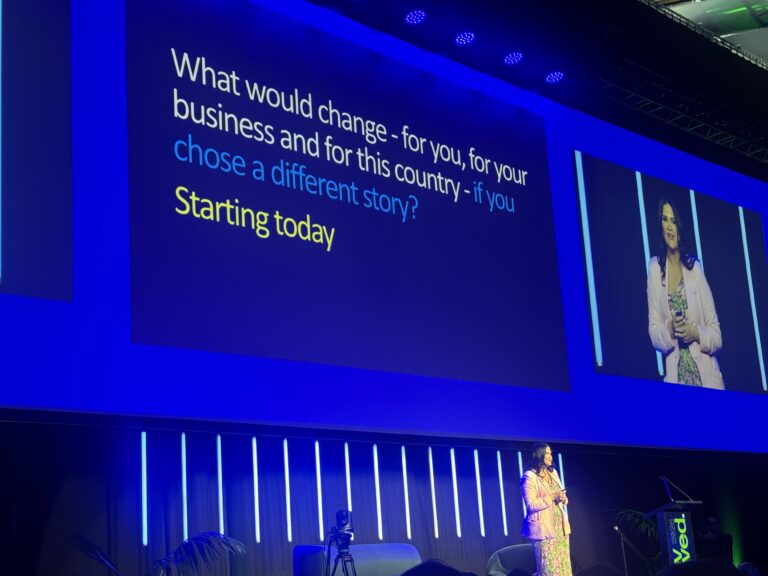
A week after I let myself out of the house, I was at Revved., where my friend Nicola Taylor of Tax Traders gave the best keynote I’d seen in a long time. Her argument: strategy is rendered inert when it’s built on a limiting, untrue story.
Like all great talks, it ended with a practical how-to in four steps: name the story, interrogate it, test it, and let the evidence rewrite it.
This isn’t about affirmations in the mirror. It’s about the structure of how you look at the world. I couldn’t help thinking about all that time in the dark, listening to my own unhelpful stories.
Limiting beliefs in business
It scales into organisations, because businesses tell themselves stories too:
- We’re too small to compete.
- Our people won’t adopt new tools.
- We’re so far behind on AI there’s no point starting.
Each one quietly shapes what a leadership team considers possible, and so what the strategy even attempts. Name them. Interrogate them. Test them. Let the evidence do the rewriting.
A story worth betting against
Some stories deserve to be challenged harder than others. On Slideshow with Dave Hayward, Nyssa Waters, CEO and co-founder of Possible AI and RCRT, told me she’d bet a US venture capitalist real money that within five years, probably two, he won’t be using email. He took the bet. Most of us would, because email feels like the weather: annoying and permanent.
That’s a story too. Nyssa’s point is that plenty of the tools we treat as fundamental are on their way out, and that AI, deployed well, could hand the low-value busywork to machines and leave people with the work humans are good at: judgement, creativity, conversation, and being present with the people who matter. “I hope AI can restore us to being human again,” she said. So do I.
Try it this week
Write down one story your business tells itself about what it can’t do. Ask what evidence supports it, and what would have to be true for it to be wrong. Then run one small test.
If you’d like a hand working through the stories behind your strategy, book 30 minutes with me.
Questions people ask
What are limiting beliefs in business?
Untested assumptions a business holds about itself, such as “we’re too small” or “our customers won’t pay for that”, that quietly narrow what it attempts.
How do you overcome limiting beliefs in a team?
Name the belief, question the evidence for it, run a small test, and let the result decide. Nicola Taylor’s four steps: name it, interrogate it, test it, let the evidence rewrite it.
How do limiting beliefs affect strategy?
They set the boundaries of what a strategy even considers. A plan built on a false story will underperform, however well it’s executed.
This article first appeared in Bright Objects, my fortnightly newsletter on brand, marketing strategy and AI for business and tech leaders. Subscribe here.
Sources and further reading
- Slideshow with Dave Hayward, Nyssa Waters: AI can free us to be more human
- Mark Manson, The Subtle Art of Not Giving a F*ck, and How to Build Unstoppable Confidence
- Revved.
If you know your business is all steak and needs some sizzle….. we’d love to hear from you.

Dave Hayward


Subscribe to Bright Objects Your essential marketing & tech insights
Warm personal stories wrapped around solid business, revenue and marketing strategy, how-tos, technology discussion (especially AI), philosophies and tactics. Occasionally, we’ll talk about personal productivity and things important to us (like astronomy and dogs).